

Book review: Retire on Less Than You Think


Photo credit:
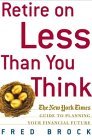
Cover image from Amazon.com Halfway through Fred Brock's book Retire on Less Than You Think: The New York Times Guide to Planning Your Financial Future, I was mentally drafting a review that would call it good but kind of basic for most Wise Bread readers. Then it clued me in to an oddity of federal law that could make the difference between keeping or losing my health insurance. That one bit is not only worth the price of the book, it could easily be worth my entire life savings. Actually writing the review, I realized the book is full of bits like that. I happened to know most of them already, but I've been studying this stuff for years. I have to say this is a must-read book for anyone who hopes to retire before they're 65.
[Updated to add: A revised version of this book has come out since I wrote this review. Check out Retire on Less Than You Think, Revised Edition: The New York Times Guide to Planning Your Financial Future.]
Brock spends nearly a third of the book on one rather obvious idea: You can retire on less if you spend less money! This will, perhaps, not be a great revelation to the average Wise Bread reader. To be fair, though, the book is aimed at affluent New Yorkers (and affluent folks from other east and west coast cities) who would be shocked at the notion that they might live anywhere other than where they do. Perhaps it is important for those readers that he so patiently makes the case that you can spend less money without reducing your standard of living at all--and that you can spend a lot less money if you're willing to make only slightly more drastic changes in the way you live.
In fact, the best parts of this book are in this area, because Brock talks about actual people who have retired on less money than some people might consider possible. He covers a pretty wide range from barely frugal at all to pretty darned frugal (such as Elton Pasea who saves enough of his $1200 a month from social security and a pension to take annual bicycling vacations in Europe).
Brock goes to quite a bit of effort to debunk the notion that you'll need to be able to replace 70% or 80% of your pre-retirement income from savings or your pension in order to retire. Rather, you need to replace that fraction of your spending (which had better be less than your income, if you're hoping to retire early).
After making the case that early retirement is within the reach of almost anyone who lives on less than they earn, he gets into the good stuff. There's a chapter on simplifying your life that's good, if a bit basic. A chapter on deciding where to retire with some good resources for finding someplace affordable and some sound advice on choosing to live near family and with access to things you want to do. There's a section on analyzing your assets, with some good info about reverse mortgages for people who own a house. There's a chapter on health insurance that had that great tidbit for me. It rounds things out with a chapter on social security and then some worksheets, suggested resources, and an excellent index.
(The tidbit for me, by the way, had to do with the the federal law HIPAA. That's the law that prompted all of your doctors and pharmacies to start giving you privacy notices. It also assures that, if you change employers and go from one group plan straight to another, the new plan can't exclude coverage for preexisting conditions. (I knew that part.) It also (and this was news to me) requires insurers to offer coverage to anyone who has left a job, continued their coverage under COBRA, and then exhausted the COBRA coverage. I'm still covered under my employer's insurance as part of my severance package, but I hadn't been planning on exhausting the COBRA coverage--I'd been planning to use that only as a back-up in case I had trouble finding insurance. I didn't understand that by getting an individual policy earlier, I'd lose access to guaranteed, non-cancelable insurance! That one point is probably of interest to only a small number of people, but it's critically important to anyone leaving a job and not yet eligible for Medicare.)
Retire on Less Than You Think by Fred Brock. It's a short book--you could read it in an afternoon. But in addition to advocating for the idea that a simplier life lets you follow your bliss--to retirement or where ever else it might lead you--there are dozens of bits of information that could spell the difference between a happy retirement and having to go back to work in your old age.
Tagged: Personal Finance, Frugal Living, Retirement, book review, books, frugal life, frugality, retire, retirees, retirement planning, review




Disclaimer: The links and mentions on this site may be affiliate links. But they do not affect the actual opinions and recommendations of the authors.
Wise Bread is a participant in the Amazon Services LLC Associates Program, an affiliate advertising program designed to provide a means for sites to earn advertising fees by advertising and linking to amazon.com.


It definitely does take less than one might think.
"HIPAA ... requires insurers to offer coverage to anyone who has left a job, continued their coverage under COBRA, and then exhausted the COBRA coverage."
My experience with this required coverage is that 1) it is minimal (usually a state-mandated minimum of coverage) and 2) it is EXPENSIVE. Note that the insurance companies are *not* required to offer you the very same plan you COBRAed, or the same COBRA price you were paying... just *a* plan.
In North Carolina (and probably other states), the plan you are offered after COBRA expires has no prescription coverage, and is basically catastrophic health insurance. The details of the plan are mandated by the state of NC. Before counting on this plan, it would be a good idea to check out your state's minimum required plan... probably on the state's .gov page somewhere, maybe on the Insurance Commission home page or some such.
That all said, it is still better to have limited, expensive coverage than no coverage at all, and perhaps (I don't know the HIPAA law on this point), using this post-COBRA coverage for a while and then getting, say, a new employer-based plan, would count as continuous proof of coverage and thus eliminate new waiting periods for pre-existing conditions. I'm not sure on that one, though.
Anyway, great review... I'm off to buy the book.
Ann
Well, I went to amazon to get the book, and found that it was written in 2004! No thanks... things have changed way too much since then.
However, a revised edition will be published in December of 2007 so I've pre-ordered it and look forward to getting it early next year.
Ann
There are definitely limitations to HIPAA, and it isn't decided that I'll go with a HIPAA plan. (A lot more research to do before I make any decision.) But before I had been thinking that I ought to get an individual plan early, so that if I turned out to have trouble getting insurance, I'd have time to come up with an alternative. Now, though, it seems like it would be safe to stick with COBRA to the end (while doing cost-benefit analysis between the HIPAA plan and an individual plan, that might be cheaper but would be cancelable if I got sick).
One advantage with waiting is that I've currently got cheap insurance from my employer (while my severance period lasts), so I'd only have to pay the high COBRA rates for a few months at the end. I had been worried that, if I waited, I might get stuck with no insurance and not enough time to come up with a solution.
I agree that this is a good book to read -- I own this book and several others. My favorite is "Retirement on a Shoestring" by John Howells. I have many health issues and would love to retire but can't yet because of family issues. When I'm forced to retire by my health, I don't think that I can live on social security and my savings. I'm also extremely worried about the direction that our country is headed: foreclosures, jobs going overseas, war with Iran(?), etc. In the meantime, I am busy "right-sizing" and trying to hang on. Am currently reading "Right Sizing Your Life" by Ciji Ware and highly recommend this book!
All I could think when I saw this was the title of the book just didn't sound right. Retire on less than you think? I didn't realize retirement was paid for by thoughts. Retire on less than you think you need makes more sense. Semantics, I know.
Plus, I would imagine most people either really under-estimate or over-estimate what they need to retire on.
In any case I'm just tired of retirement books telling people like me, who already have retirement accounts and are in their 20s-30s: "Good for you! You started young, don't worry!" Maybe I'm just getting burnt out on personal finance.
Thanks for the review. I have feeling of lot of boomers will need all the practical retirement information they can get. I just discovered your site!
www.retirementthink.com