



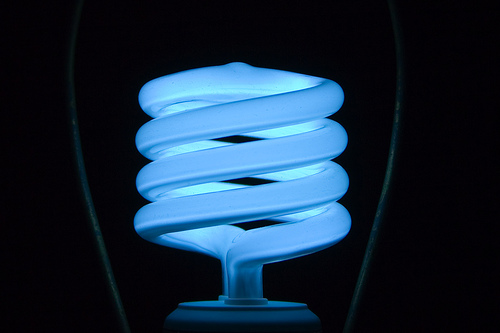
I’ve embraced the compact fluorescent light bulb revolution wholeheartedly. I preach their money-saving abilities and cite statistics about energy. I comment on brands and varieties (daylight bulbs remain my favorite). I even point to them as environmentally friendly options since the use of CFL bulbs practically guarantees less light bulbs kicking around the local landfill. But, with the growing use of CFL bulbs, a little problem with that claim that a purchase of a CFL bulb is support for environmentalism. You see, when more CFL bulbs are used, more are also thrown away. And CFL bulbs contain mercury.
Mercury is one of those substances that worry health experts. Pregnant women are supposed to avoid exposure. Dentists prefer to replace mercury fillings. Heck, we’re even supposed to limit our intake of tuna fish because of concerns about the mercury levels in the fish.

Now, all is not lost. CFL bulbs are still a better option than most of their counterparts — as long as users take a little care with disposal. Essentially, environmental experts, such as Brad Heavner, the state director of Environment Maryland, recommend recycling your CFL bulbs, rather than just throwing them away. Since mercury is classified as hazardous waste, recycling the bulbs guarantees that said waste doesn’t get dumped somewhere that they could harm water supplies and other parts of the environment.
The problem? Very few recycling programs actually accept CFL bulbs. Heavner said in an interview with the Baltimore Sun: “I have a bucket of bulbs in my basement, and they’re going to stay there until they do make it easier.†That’s right — even the environmental expert doesn’t have access to an easy way to recycle his CFL bulbs. At this point, only nine states in the U.S. have reasonable CFL recycling programs. Activists, such as Heavner, are working on the rest.
In the meantime, though, if you don’t have easy access to a CFL recycling program, you have fairly limited options. You can use Heavner’s bucket-in-the-basement strategy, or go ahead and throw out your bulbs. Some stores will also take used CFL bulbs, including all Ikea stores and some Ace Hardware and Tru-Value Hardware stores. If you don’t have access to such stores, consider stopping by the manager’s office at the store where you buy your bulbs. Tell them you’re interested in a recycling program — many companies seem to just be waiting to hear about customer interest.
A side note: If you break a CFL bulb in your home, the EPA recommends the following: clear everyone (both humans and pets) from the room, ventilate the area by opening windows, and shut off the furnace. You can then commence clean up procedures. These precautions are merely that: you don’t need a hazmat suit to clean up a broken light bulb.
Disclaimer: The links and mentions on this site may be affiliate links. But they do not affect the actual opinions and recommendations of the authors.
Wise Bread is a participant in the Amazon Services LLC Associates Program, an affiliate advertising program designed to provide a means for sites to earn advertising fees by advertising and linking to amazon.com.


Good news for those living in El Paso County, CO and Teller County, CO - El Paso County has a household waste program that also includes disposal of CFLs.
According to their PDF file:
"The El Paso County Household Chemical Waste Collection Facility accepts the following items that contain mercury: fever thermometers, light switches, thermostats, and fluorescent lights that do NOT have green tips (green tips indicate environmentally friendly products that can be safely discarded with household trash.)"
They also have a very extensive recycling program for chemicals, electronics, batteries and other items.
I urge those in my area to check out their website at:
http://adm.elpasoco.com/Environmental_Services/Solid_Waste_Management/
They can be reached at 719-250-7878
That phone number should read 719-520-7878.
Sorry about that.
I am hoping that as these bulbs wear out (in 5-7 years) that more places will have easier recycling programs. I have turned in fluorescent bulbs (large ones, that I assume also have mercury - see how stuff works) at recycling events (not through weekly pickup) but it will be nice to see a a comprehensive program. I installed CFLs where I could in my house, and my utility bill has dropped by $1 per day.
I don't understand why this has become such a big deal. Fluorescent lights have always contained mercury -- proper disposal for CFLs is no different than what proper disposal for fluorescent tubes has been for decades.
You are also not supposed to put paint or batteries in the garbage (among other things such as containers from many cleaning products or pesticides). The proper place to dispose of your CFLs is almost certainly the place that you (should) have been taking these items.
And if you haven't been concerned about properly disposing of hazardous household products before, why the sudden concern about CFLs?
Wait for that "blue tinge" to be taken out of LED based bulbs, and then we've *really* got a contender. Recent tests have shown something like 100+ years for a MTBF for many LED style bulbs; having light bulbs that will last longer than I will seems pretty compelling :).
@Winston
Because of the relatively "sudden" push to change over CFLs, many people who used to use incandescent lighting in their homes suddenly have fluorescents, creating a need for a bit more education on the subject. And believe me, I am in favor of properly disposing of batteries, paint and (perhaps more importantly) computer parts. People have been reminded over and over of the need to properly dispose of paint and batteries. There just isn't the sheer amount of long-term discussion for CFLs and computers.
Um, hey guys, nobody told me I was trading in my admittedly energy-wasting bulb for something that has more disposal instructions than a nuclear reactor.
I should have known something was up when Walmart started pushing them-- they're probably made with the toxins left over after the Chinese finish making our kids' toys.
I'm waiting for LED bulbs to become more practical/affordable. In the mean time, I'm hoping no one is throwing away perfectly good incandescents just to install a CFL. If you're going to change to CFLs, at least wait until you have a burned-out bulb!