

Feed items
How I use negative feelings about finances to my advantage
This article is by staff writer Kristin Wong.
I have never had much patience for dwelling. Time is a limited resource and I want to use it in the best possible way. Dwelling is a waste.
I also have little patience for sweeping things under the rug and pretending to be happy when I’m not. Ignoring a problem is a great way to ensure it will come back to haunt you later. Plus, in the meantime, it looms in the background, ruining just about everything. Like dwelling, sweeping things under the rug is a fruitless use of one’s time.
Should you consider ETFs for your portfolio?
This article is by staff writer William Cowie.
Exchange-traded funds (commonly known as ETFs) are a relative newcomer to the American investment scene, having been approved to be publicly traded by the New York Stock Exchange just over 20 years ago. However, in that time, they have managed to capture about $1.7 trillion in investor money. Why are they so popular, and should you consider investing in them?
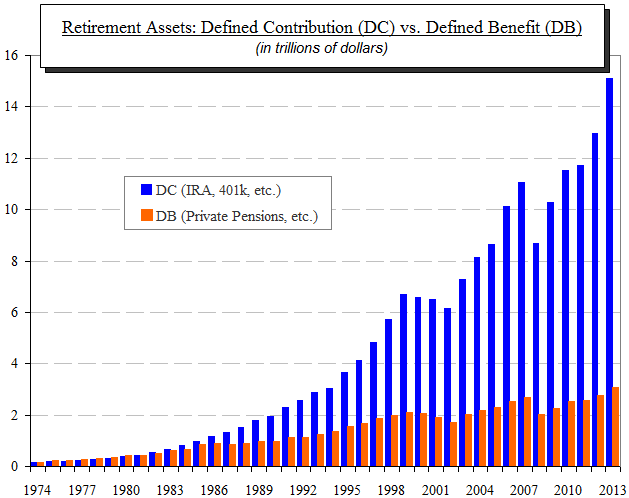
Over the past 40 years we have witnessed a major shift in how America funds retirement. The chart below shows how private employer pensions and other defined benefit plans have been displaced by defined contribution plans (things like IRAs, 401(k) plans and others):
(source: Investment Company Institute)
Cold and flu season: Stock your medicine cabinet for less
This article is by staff writer Lisa Aberle.
Though our family has already had one sneak peek, cold and flu season is about ready to really get started.
Because I would like avoid as many sick visits to the doctor as I possibly can, I decided to check out our medicine cabinet and make sure it is ready for this winter — and beyond.
What you should include in your medicine cabinet
Obviously, what you should include in your medicine cabinet depends on your needs, but here is a list to get you started. Oh, and I am not a doctor. Obviously. Read the labels. Use common sense.
Ask the readers: How does media coverage affect your charitable donations?
This article is by editor Linda Vergon.
A 2006 study from The William Davidson Institute at the University of Michigan showed how media coverage of the 2004 tsunami influenced charitable donations. For their analysis, they had to isolate the effect media coverage had on donations, so they controlled for tax incentives, agency-specific effects, and “donor fatigue” (meaning that more exposure to an event caused people to be less willing to donate). What they found was that donations increased by 13.2 percent for the average relief agency after an additional minute of network news coverage. A single 700-word story in the “New York Times” or the “Wall Street Journal” increased donations by 18.2 percent.
How to curate your social media presence when job-hunting
This post is by staff writer Honey Smith.
Recently, I’ve been posting on job-related topics like networking strategies and job tenure. Because my current position entails working with college students, I’ve been asked on numerous occasions to talk to various undergraduate groups about getting into graduate school. In fact, I’m giving one such presentation next week.
Many of the things I cover in such presentations are also broadly applicable to any situation where you are competing against a number of other applicants for a position. This includes job-hunting. I’ve also taught entire units on job-hunting in upper division business writing courses at the university level. Much of the advice that I give is pretty standard:
-
Research the position and the company
Painless ways I save money in every category of my budget
This article is by staff writer Kristin Wong.
I get frustrated when people don’t understand what it means to be frugal. A few criticisms of frugality I’ve come across:
-
Frugality is a waste of time.
-
Frugality distracts you from earning more money.
-
Frugal people deny themselves of any enjoyment.
I’ve already written in detail about how these arguments are silly. They might apply to being cheap, but they don’t apply to being frugal.
My two favorite splurges are dining out and travel. Over the past few months, I’ve splurged quite a bit. One night, driving home from dinner with a friend, a little voice in my head said:
Is living without credit cards the best way to stay out of debt?
This article is by staff writer Holly Johnson.
Americans might be more responsible now than they were in the early 2000s when it comes to the use of credit. At least, that’s what the evidence from a Gallup poll taken earlier this year seems to suggest.
The Gallup poll, which was based on random telephone interviews with 1,026 adults, shows that a full 48 percent claim to pay their credit card balances in full when the bill comes due. Not surprisingly, the opposite group, those who carried a balance each month, came in at a record low percentage since Gallup began recording this metric in 2001.
Do nice guys finish last … financially?
This article is by staff writer Lisa Aberle.
While it wasn’t a dark and stormy night yet, an ice storm was coming. The last time we’d had an ice storm, we were kidless, and we lost power for five days. The romance of sleeping in front of the fireplace quickly cooled off along with the temperature in the house. If we lost power again, 39 degrees just wasn’t going to be acceptable with two kids.
That’s why my husband took a trip out to the shed to get our generator ready to combat a potential loss of power.
Except he couldn’t find the generator. After a few minutes of brainstorming (Did I put it somewhere else?), he called someone who frequently borrows our stuff.
“Your generator?” said The Borrower, “Yeah, when you were out of the country last year, I let somebody borrow it. I’ll give him a call.”
Ask the Readers: Is financial ability intrinsic or learned?
This article is a guest post by Maggie O’Neill.
Thanks to my big brother — and by that I mean my oldest brother — I’ve always had an interest in savings and retirement planning, although I haven’t been able to do much more than think about it until lately. That oldest brother, Pete, is the person responsible for opening my eyes to investing and, in fact, made the first financial stake for me when I was in my 20s by literally opening a Berger account in my name and depositing the first $50.
Is your 401(k) keeping up with the Joneses?
This is a post from staff writer Robert Brokamp.
Would you like to know how much your friends or relatives have in their 401(k)s? Of course you would! And once you found out, you’d compare their balances to yours. After all, most of us want to know how we’re doing compared to everyone else — so we can endeavor to keep up or even do better. Call it “beating the Joneses.” Perhaps it’s a vestige from many generations past, when relative standing within the tribe dictated access to resources and opportunities to pass along one’s DNA. Oh, wait — it’s still that way today.
Photo credit: Mecum Auctions




Facebook
Become a fan
Twitter
Follow us
RSS
Subscribe