

Why don't people share more?


Photo credit:
Viewoftheworld I saw an article recently suggesting that neighbors share a garbage service. One neighbor hires the service, the other kicks in to cover half the bill, and both bring their stuff to the same spot on the curb on garbage day. The standard deal with a hauling service will take away a lot more garbage than a small household produces (or even a large household, if they compost and recycle). It's a good idea, and not just for garbage. Why don't we see more of that?
It used to be normal for people to share stuff. From small-scale sharing, like neighbors sharing tools and kitchen supplies, to large-scale sharing, like villages with communal bread ovens, where housewives would make their bread dough in their own kitchens, but all bring it to a central oven for baking.
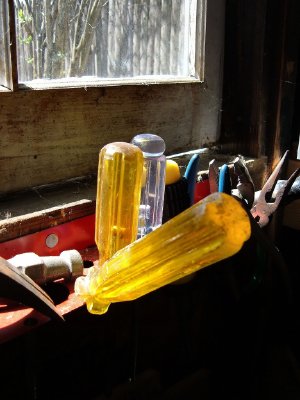
There's huge opportunities for that to happen still. Look in any suburban garage and you'll see a bunch of stuff that only gets used for a few hours a year--tools, garden implements, a snow shovel, a lawn mower, a BBQ grill. Look in the garage next door, and you'll see a very similar collection, give or take a leaf- or snow- blower. Surely there's a more efficient way for people to tend their lawns and gardens than for every family to invest thousands of dollars in stuff that spends 99% of its time sitting idle.
Of course, there are a lot of reasons people want to own their own stuff.
One good one is that some things all want to be used at the same time. Outdoor Christmas lights, for example, spend 11 months a year in storage, but the few weeks a year that they're up are the same few weeks for everyone.
People want their own because they want a particular one. That's fair. There's a market out there for stainless steel BBQ grills whose prices put me in mind of Pentagon procurement scandals. I wouldn't buy one, but that's what the free market is all about.
People want their own because it's convenient. If you just have your own, you can do stuff on a whim, without planning ahead. Also, if you do plan ahead, you don't have to coordinate your plans with anyone else (or deal with the conflicts when plans don't mesh).
People want their own because they want the item to be treated well. In college I lent my typewriter to a girl in the dorm and it came back with white-out all over the bit of clear plastic cover that had (until then) let me see the letters I'd just typed. (I'm no longer bitter about that.) There are lots of things that can stand up to heavy use, but need a certain minimum amount of maintenance--shovels need sharpening--and it's human nature to be a bit more casual with stuff that isn't theirs.
Contrariwise, people also want their own because they don't want to have to worry abut taking good care of it. I know a guy who has never changed the oil in his lawn mower. His dad harped on him a few too many times about taking care of his stuff, so now he doesn't. He figures he'll just use it until it grinds to a stop, and then buy a new one. Last time I talked to him, the lawn mower was still going strong, long after he'd expected it to have failed.
Having said all that, I think the real reason a lot of people want their own comes down to being estranged from their neighbors. The social structures that used to let people expect to borrow from their neighbor and expect their neighbor borrow from them simply don't exist any more. In many neighborhoods, unless they have children the same age, people don't even know their neighbor's names, let alone know them well enough to ask to borrow the lawn mower.
And being estranged to that extent makes people's fastidiousness kick in. If you don't even know your neighbor well enough to borrow their lawn mower, you'd certainly feel uncomfortable if they asked to run a load of laundry in your washing machine. Think of the cooties!
The only way we see much sharing nowadays, except within families, is when an institution supports it. I share washers and driers with my neighbors, but none of us own them--the apartment complex has them in every building. I don't own a grill--the apartment complex has charcoal grills scattered about in the common areas. I do own a lot of books, but I read a lot of books I don't own--they're owned by the public library.
Basically, sharing has been institutionalized.
The fact is, though, that sharing doesn't just depend on neighborliness, it creates neighborliness. Neighbors who depend on one another for small things gradually learn that they can depend on one another for big things.
Sharing is frugal, but it's also part of the adhesive that holds society together.
Over the past couple hundred years, we've become so wealthy that everybody can afford to have their own everything. I think that's likely to change, as energy gets more expensive, and as people come to realize that externalized costs (like environmental damage and climate change) are still costs--people will find themselves less wealthy and will turn to their neighbors for support. The social structures that make neighborhoods work will come back.
People who can get ahead of the curve, and share things with their neighbors before it's cool again, will have a leg up on the rest.


Disclaimer: The links and mentions on this site may be affiliate links. But they do not affect the actual opinions and recommendations of the authors.
Wise Bread is a participant in the Amazon Services LLC Associates Program, an affiliate advertising program designed to provide a means for sites to earn advertising fees by advertising and linking to amazon.com.


it really works well. My stepfather just bought a new, top 'o the line snowblower- but is too ill to do the actual snow removal himself. His neighbor will take care of the snow removal for use of the snow blower he couldn't afford.
Other cultures look more into sharing opportunity. The neighborhood where my church is has a large Vietnamese population. Groups of families will chip in to buy items that can be shared, like a vacuum cleaner, to save money. Not everyone in the apartment building needs to have a vacuum 24/7- so this is bought for common use. It makes a lot of sense, until that time your kid spills cereal all over the floor and you can't quite track it down. (but then, maybe they adjust habits accordingly to not have cereal in the living room- who knows).
When we moved to our rural neighborhood, I was concerned about the cost of garbage pick-up. We are on a limited income and because we recycle and compost, we generate maybe one bag of trash per week at most. So, for the past year and a half we have shared garbage pick up with a neighbor. My initial approach was to suggest an exchange of service by agreeing to take the neighbor's recyclables into the recycling center with mine. Even though my encouragement has (unfortunately) still not inspired them to become avid recyclers, I compensate their sharing of garbage service by taking them a home cooked meal every now and then. It works out well since I love to cook and have a tendency to make more than enough anyhow and she doesn't have as much time or inclination to cook.
I gave up lending things to people when they came back broken too many times (or didn't come back at all...). "If you can't afford to lose it, you can't afford to lend it".
yes - thanks for saying that. I totally agree (sadly)
Tried lending/sharing in college, mainly clothes. Gave that up after about one semester as new leather gloves came back with cuts, Aran sweater back with red wine stains, etc.
Tried co-owning electric hedge trimmers with good friend. After each of us using them twice, he decided our 16 feet of hedge was too heavy use, of course, his 20 bushes/trees were okay. Sold the trimmers to him for our share of money spent.
I've found it safe to share with family, and occassionly with a neighbor who needs a tool for a short period of time. As a rule, not sharing keeps us happy, our neighbors friendly and family still on speaking terms.
There have always been people who would break stuff or fail to return it, but their neighbors quickly learned who they were, and excluded them from the group. This was a powerful pressure, and people would not go against it for trivial reasons.
The social structures that supported the system used to be universal--every culture had them--but they've all but disappeared in middle-class America. It makes sharing a more risky activity.
Still, I think it's worth working around the edges to bring these systems back. The advantages accrue not only to the individual (who doesn't have to invest thousands in stuff he can borrow), but also to his neighbors (who have similar savings).
Beyond that, there are further wins. There's an economic boost: Everybody saves, so everybody has more money to spend and invest in ways that benefit themselves and the community. There's also an environtmental boost: Less stuff gets made (because what stuff is made is shared) which means less energy used, less raw materials used, less pollution produced, and so on.
Sharing, if supported by the necessary social structures, is probably the best way to boost everyone's standard of living.
Sharing cell phone plans is a good option too, especially if you know a friend or family member who gets their cell plan through work and you can add a line for like $10 a month. I do this with my dad, he gets a free plan through work, I pay the $10 a month to add on and $5 for unlimited texting. Most plans have unlimited nights and weekends now so going over isn't a big issue for us.
On a practical level, I totally agree--a culture of sharing is economically and socially beneficial. But on a philosophical level, you have to be careful not to harbor a Disney themepark image of the proverbial "village." I've lived in 3rd world villages and close-knit neighborhoods, and there's a dark side to being close to your neighbors, including some of the ugliest and most bitter feuds I've ever seen over cooperative sharing arrangements (work, tools, cooperative credit circles) gone awry.
I'm with the folks above, great if you can do the borrowing/lending thing with folks who feel exactly like you do. My own experience is that when I have agreed to lend something to a neighbor or a family member, it comes back in bad shape or not at all; I've had to walk over or call and ask for my "thing" back - good snow shovel, vacuum cleaner, lawn mower, good cookware. Tacky, tacky, tacky. To be honest, I'd personally never dream of asking anybody if I could borrow anything. I plan ahead and have one of my own or do without, period. Guess my mother is the only exception to this (she thinks like I do) but again, I would just rather have one of my own if I truly need it.
I don't understand the concept of "never dreaming" to ask to borrow something.
There's always some tool needed or some odd doohickey with things like home renovations or even day to day upkeep that's not used often enough to warrant a purchase in my book. Do you rent or buy these things?
What do you with them once the intended activity is over?
Ah. Thought so. Buy it and add to the clutter. Not for me.
Very appropriate article for today's time. Now we are back at a time when we realize that the earth's resources are finite and may not be able to sustain our growing needs. This is the earth's way of telling us to cut back on your extravagance and share the limited resources. Even if we carpool to work everyday, it will help immensely in reducing our carbon footprint and preventing global warming.
Thanks for writing this!!
------------------------
My Positivity Blog http://positivityhub.com/
An original article. How refreshing. It is weird to borrow from neighbors but it can develop over time. It helps to stay in one place for a while-moving every one or two years is not conducive to developing a borrowing relationship with neighbors. I have a neighbor that asks me to watch her cats when she has to stay overnight somewhere for work and in return I borrow her stepstool/ladder from time to time. I could buy my own, but the only time I need to use it is when I need to go in to the attic maybe 6 times a year for holiday decorations that I keep up there. This neighbor also knows she can call me if she gets sick etc. to help out. I borrowed a couple cups of sugar from another neighbor on thanksgiving day (!) because I didn't want to have to run to the store again. I returned the sugar a few days later and hope that my neighbors will feel free to ask me for something sometime. It really does make you feel close to neighbors when you are helping each other out. In the case of a natural disaster, neighbors looking out for each other probably have a better chance of survival.
we live in a time when consumerism rules. you're right, we CAN afford to buy so many more things now. why borrow a book when it's only $10 on amazon.com? in the old days, it was probably more of a necessity. families didn't have credit cards to buy things they couldn't afford right then and there. technology has also made everything so impersonal. we keep our doors locked and eye our neighbors with suspicion, but we open our lives to strangers online everyday. it's all very strange, and i too would like to bring back a little neighborly friendliness and sharing.
We felt this exact same way. After having lawnmower troubles for 2 straight summers, and sheepishly asking our neighbors if we could use their lawnmower yet again, we thought, "Wouldn't it be great if we just had an agreement with a neighbor who was willing to share with us?" It wasn't just about the lawnmower either. We have a garage and house full of stuff that we use only once in a while. But it seemed that every time we had a project to do, we needed something we didn't have. We didn't want to keep spending money and space on stuff we'd only use once, and if our garage and house were any indication, there were other people in our neighborhood who may very well have the thing we needed... and feel the same way.
And so was born West Side Neighborhood Share, just last spring. We photocopied a letter from us explaining the program, a sample list of ideas, and a form to fill out, and stuck them in the doors of the people in our neighborhood. The form included a space for things they'd share, things they'd be willing to trade, and things they might want to borrow or get for trade. Then I photocopied the forms that came back and distributed the "list books" to all of the people that had turned in their list. We said we'd reinvite people 2 times per year and put out a new list book, so the lists could be seasonal, and so that if someone no longer wanted to participate they had a way out of the list book.
So what were people willing to share? The lists astonished us. They included lawnmowers, storage space, tools, a chipper, games, professional landscaping and construction advice, babysitting, small kitchen appliances, tomato starts, perennial divisions, manual labor, horseback riding lessons, pet sitting, use of a darkroom, snow sports equipment, canoes, a truck, a trailer, magazines and newspapers (after the subscription holder had read them), luggage, knitting instruction, and much, much more.
We invest time and a little money for copies, but it pays off because we no longer have to buy items for one time use. And the other, possibly more important, payoff is meeting our neighbors of all ages and actually building community in our neighborhood.
@Lynn:
As you say, those of us who live in developed countries are so wealthy that we can afford to just buy everything we need. It's more convenient than sharing, and we can afford it, so why not? And yet, a bit of neighborliness would go a long way to making us all better off.
@Joey:
What a great story! It's just what I'm talking about.
I was one of those who felt ashamed if I had to borrow something from someone else. It didn't fit in with my perception of what it means to be an adult and take care of your own family.
However, after having to live with my parents for a year after the birth of my 2nd son due to medical and financial troubles, my husband and I soon got over it. We got along so well, that we moved into their home permanently, and they built a new house next door. We share a water bill, trips to town, sundries like bulk laundry soap and paper goods, and big items (pick-up truck, commerical lawn mower, chain saws, etc.) If we have something they need, we lend it. If they have something we need, we borrow it. We also share labor on projects, and eat many of our meals together (Sundays especially.)
It's great for the obvious financial reasons, but it's also more than that..
My kids get to know their grandparents the way that kids used to know their extended families when they all lived together on farms. I get a relationship with my parents that I didn't really have growing up. We have more things together than we ever could apart. We show grace to each other if something gets broken and we always take the opportunity to make things right.
Many lessons (tough ones, albeit) can be learned living this way!
Thank you Philip for reminding us why we do what we do and reassuring me that we aren't freakish for doing so!
Didn't Ben Franklin say that the best way to make a friend is to borrow a book from him?
We need to maintain these vital ties - of giving someone a ride, sharing a lawn mower or snowblower - so we have a sense that we are in this together.
The other downside of not sharing is that people think anything is a communal area is up for grabs. The gardeners at my apartment complex are always digging up plants I put there - or suddenly the lawn chairs and little tables disappear! I out fox them by only putting recycled stuff out there, so I am not too attached to it! (& my husband didn't understand why I hauled the used plastic chairs home!) You find that a lot when dealing with people who think you are "rich" in comparison to them. That mentality makes it easy to steal....
I would love to share the Garbage bill with my neighbors but the City will have NOTHING to do with it and has it set up so that you CAN'T.
I have a "hobo" as they call it that is about 1 cubic yard in size that is emptied twice a week.
I'd be lucky if I generated that much trash in a month let alone the 8 they expect...same goes for the nice old couple next door.
Can I cancel the Garbage or use theirs or vice-versa??
NO WAY!!!! I would have to have my Water shut off as well to stop the Garbage...though they are separate items on the monthly bill stopping one stops the other.
And to top it off the County (to combat "illegal dumping"...lower the landfill fees to stop that IDIOTS!!) passed an ordnace some years ago that mandated garbage collection for all occupied dwellings and businesses.
Stop the Garbage and get a notice slapped on the door from the Government saying you have to Move Out as the house is "No Longer Fit For Human Habitation" per code.
PITA..
~ Roland
It's the convenience, the fact that no one actually cares as much about YOUR STUFF, as you care about it, it's the fact that there's always ONE person amongst several that messes the sharin' up for everybody - Like many have mentioned, it usually comes back NOT in its original condition or it doesn't come back at all...
BUT... I can't completely put it down, when I lived in Australia, after I finally got rid of my last flatmate(THANK GOD), I moved into a place by myself... like the guy in that Twilight episode, I remembered shouting, 'ALONE AT LAST... FINALLY, TIME ENOUGH AT LAST'--
After a couple of months of alone, it started to not quite be what I wanted it to be... save that fact that a neighborhood cat, liked to come and sit on the ledge of my open window, which turned from annoyance to well... yeah, it actually was ok... I complained, but that was me being contrary.
Then one day, my upstairs neighbor actually came down... and she needed to borrow a cup of milk - in all my time and years of living in apartments in the states I never had a neighbor come and ask me to borrow anything -- I thought, hey... this is kind of cool, people still do this -- and we got a chance to chat and lo and behold that cat belonged to her and his name was 'Tink'-- by this time he was spending most of his evenings lounging in my window sill and probably getting quite fat on the two meals he was partaking of -- so at the very least, daring to share might cost you a cup of milk ... but who knows you might get a lazy Saturday afternoon chat and tea ... and even a cat out of the deal.
Great topic.
We are now too much of a "me only" society. The concern and care for others is no longer the same. THis is why people can actually damage something they borrow and not feel ashamed at all. Some do not even know that they have to return.
A 3rd party doing the lending and sharing may be better accepted. Say like a non profit.
Ideas like yours may make tremendous changes in society, but mankind will prefer to be left alone to waste.
(I wish I lived in Joey's neighborhood. Those folks have got it together.) We have neighbors next to us and across the way that would be open to something similar I am willing to bet.
could someone show me an example of the form, list, etc. that I would need to create a neighborhood share. I am very interested and would like to put something together for my neighborhood.
I'm happy to share the documents we use, but someone will have to tell me how to get them to you. I'm new to this comment-posting thing.
Two examples: A neighbor and I rented a lawn airator. We used his truck to get it, we paid for it, and then we worked together to do both lawns. When I grew up on our farm, my dad owned a combine which he used to harvest other families' fields. They paid us, so we made some money, and they got their harvests in without having to own and maintain a large machine. In our small town borrowing from neighbors is the norm. An elderly neighbor had a riding lawn mower. She let a younger neighbor, who had a push mower, use it for his lawn if he would mow hers.
Currently, though, we cannot share garbage services with our neighbor(s). We get charged a monthly fee whether or not we ever use it. The most we can do is put our garbage over next to our neighbor's garbage so that the truck doesn't have to make so many little stops, which saves fuel and in-and-outs for the driver.
Good post, good comments. Many of them seem to reflect the Dagwood Bumstead-Herb Woodley experience that loaned items come back damaged or don't come back at all. More modern comic strips never mention any kind of sharing, as far as I can recall.
A long time ago, borrowing and lending as well as shared ownership (boats, for example) seemed to be much more common. As our standard of living grew, sharing, even within families, dwindled. What I wonder is whether this development is just based on the convenience that stems from affluence making it possible to own most things we're likely to need. Or is it that human nature resists sharing? In which case, affluence has just allowed for the full expression of this natural tendency toward individualism and territoriality.
The fact that so many who commented have been willing to try lending provides a little support for the first, more optimistic possibility. After all, the best long-term solution to the Prisoner's Dilemma is to cooperate as long as the other party does the same. If the other prisoner cheats, of course, then you have to nail him.
When our neighbor moved in we offered to share our (private) garbage service as we didn't begin to throw away what was allowed for pick-up. Over the past three years we have grown to share their ride'em lawnmower. We always add gas and make a contribution every year toward upkeep.
This past year we cut down limbs on both properties together and now use the wood to hold collective evening sits by the firebowl. Everyone brings their own refreshments and after an hour or so drift off for dinner. We also share trips to our pool in summer and their hot-tub in winter.
We rototill our individual gardens together and share seeds and excess produce. We have become so close that we have taken two cruises together. It is a great feeling to know that help on any project is right next door.
We also have on the property a large firepit for burning trash and 3 neighbors on the other side share in that. There sure are lots of good conversations over the blazes. Our huge orange tree produces for the extended neighborhood and we trade oranges for pink grapefruit.
Anymore, I check with the neighbors before I purchase any outdoor equipment. Usually, someone already has what I need.
I love the idea of circulating a list. Thanks for all the great thoughts.
Joey, if you email the docs to me, I can attach them to this blog post.
My email address is <pbrewer@prairienet.org>. (Don't cringe over my posting my email address. It's been up on my website since the late 1990s. I don't think posting it here will bring me more spam than I already get.)
Sharing has become institutionalized to the extent that people see government and business as "them" rather than "us". Several comments talk about the garbage service as something that is being done to them. We share garbage services, roads, pools, cable systems, ambulances, and all of the activities of local, state, and federal government. These are all administered -- or at least regulated -- by "us": by public boards, committees and councils.
A few weeks ago, I blogged about an article in which someone expressed contempt for getting to know their physical neighbors, at the expense of virtual interaction. The money quote was, "I prefer to attend to friends and lovers through our cell phones rather than allow geography to determine who I can and can't relate with." If you're going to share effectively with people, you have to get to know them first and there are a fair amount of people who don't want to even do that.
Building a functioning society, where people know one another and can work together toward common goals is hard work and requires engagement both at the neighborhood level, but also the community level. It takes a lot of time. Sharing our time, to sort through these issues and make wise decisions for our community, is often the hardest thing to get people to do.
I live in an apartment building. It’s a fairly big one, too. The thing with living in such buildings is that people hardly know each other. I think I’d easily miss my neighbors when walking in street. It’s also quite hard to collectively agree on anything in such a building. As soon as someone mentions money it’s a deal stopper… And things need fixin’ or replacing. Living in an apartment building really shows you how far apart people can be, yet still live under the same roof and sharing most of it.
Great article! It is much better for the planet if we share our resources rather than each household needing to have their own. But, as we can see from all these comments, problems sometimes do arise in these informal sharing situations.
There are other "institutionalized" ways to share that are regulated and eliminate the personal hurt feelings when one neighbor breaks another neighbor's things. Car-sharing is one example. Tool lending libraries are another.
I wrote a post on my blog not long ago about how learning to share and borrow can help us to save resources: http://www.fakeplasticfish.com/2007/10/learning-to-share-and-borrow.html with links to tool lending libraries and other ideas.
I haven't followed all the comments in this thread, so my apologies if someone has already brought this up.
Awhile ago I found this neat website that's meant to encourage such sharing; it's called neighborrow.com. Basically, you sign up for an account and post things you're willing to share. It doesn't look like it's taken caught on very much just yet, but I think it would be really neat if it did. I think they just added a feature to allow private "neighborrowhoods" so at least you can start sharing with your friends...
People are keeping to themselves more and more. It's normal nowadays for neighbors to never have any interaction.
What a great and refreshing topic!
I haven't read anything like this in some time. Living in NYC, you very rarely see anything like what's described here. I live in an apartment building, and we have mostly friendly neighbors, but don't really have conversations. I agree, for the most part, with what Fazed Reality said. This post has definitely got me thinking. Its inspired me to write a post about purchasing items, and perhaps something more...
@joey, would you mind emailing me the form you use at frugalnyc at gmail dot com? Not sure if there is an attachment on this post already since I'm reading from a mobile blackberry device.
Thank you!