

Frugalize any recipe


Photo credit:
Philip Brewer My wife picked up a cookbook at the library--one of those beautiful cookbooks with a gorgeous pictures of each dish. It had an above-average number of dishes that appealed to me. But, like a lot of cookbooks, it was written with no thought of holding the line on costs. That didn't matter, though, because my wife and I are old hands at doing that ourselves.
The fact of the matter is that we never cook a recipe just as its written (except for candies and confections, which are sort of a special case). We change recipes for many reasons:
- to leave out things we don't like or that someone is allergic to
- to add things that we do like or that we have and want to use
- to leave out things that we can't get or don't happen to have on hand
- to combine things that we think will go together, even if the cookbook authors didn't think of it.
It occurred to me, though, that lots of people don't do this--they either cook something that they know how to cook, or else they follow a recipe. What we do amounts to using recipes without necessarily following them. I thought it might be useful to show a worked example, and then talk a bit about the general principles.
Here's a frugalization of the Sesame-Garlic Sirloin Steak from the book my wife checked out of the library last week, Cooking for Two: Efficient and Delicious Meals.
Now, if what you want is a thick, juicy steak, it's tough to come up with a good, cheap substitute. In this recipe, though, the steak wasn't served that way--it was served cut into thin slices. If you're going to cut it into thin slices anyway, I figure you might as well use pot roast. (Sirloin was going for $5.99/lb.)
I looked in the grocery store flier and found top round roast on sale for $3.99/lb, and would have used that, except that my wife spotted one package that was marked down even further because its sell-by date was tomorrow. Since I was going to cook it today, that was fine, so I snapped up a roast for just $1.58/lb. It's a fairly small roast, (a pound and a half) but there'll still be plenty left over to make sandwiches tomorrow (french dip or maybe italian beef) and maybe again the next day.
I pressure-cooked the meat. It's the quickest way to cook a roast and it does especially well with slightly tougher cuts of beef. Â
I put a tablespoon of oil in the pressure cooker and browned all sides of the roast over medium heat. Then I added 2 cups of water (because I wanted one cup of broth for rice for this meal, and another cup for the french dip tomorrow), and then cooked it at high pressure for 24 minutes (because the book that came with the pressure cooker says 12 to 15 minutes per inch and the roast was about 2 inches thick). After 24 minutes, I turned off the heat.
While the pressure cooker was depressurizing, I made the sauce. Â
The sauce in the book had 2 tablespoons each of soy sauce and hoisin sauce, which would have been fine except we don't have hoisin sauce and I wasn't going to buy a bottle just to fix one meal. What the hoisin sauce adds, though, is a bit of sweet, a bit of sour, and a bit of hot. So, I took the sauce recipe from the book, boosted the soy sauce from 2 T to 3 T, and added a bit of honey, a bit of vinegar, and a bit of hot sauce. (The hot sauce we use is very hot, so I just added a little bit. If you use a milder hot sauce or you like your food really hot, add more.) Here's the sauce I made:
3 T soy sauce
2 T roasted sesame seed oil
2 T minced garlic
1 T honey
1 T vinegar
8 drops hot sauce
In the book it's used as a marinade, but I just heated it up in a sauce pan and then poured it over the thinly sliced meat just before serving.
As I said, the book has beautiful pictures of the dishes. The photo for this dish was made especially attractive by sprinkling the meat with toasted sesame seeds. We didn't have any sesame seeds in the pantry, but it turns out that you can buy four or five times as much as you need for a couple servings of sesame beef for 35 cents, so we went ahead and bought some. In the book they also sprinkled some cilantro on the beef, but I hate cilantro, so I used parsley instead.
After the cooker depressurized, I put the roast on the cutting board and (while it rested), I used one cup of the cooking liquid to make some instant rice. (Normally we wouldn't have used instant, but it just worked out so well using the same cooking liquid.) The rest of the liquid I saved in a container in the fridge and will use to make the dip for french dip sandwiches tomorrow.
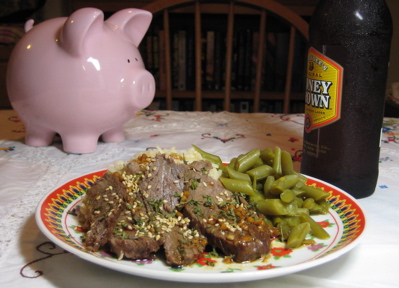
In six or seven minutes, once the rice was ready, I carved a few thin slices of the meat (cutting against the grain), poured on a little of the sauce, sprinkled the sesame seeds and parsley, and put the plate down for the photo shoot. Once I'd gotten a picture I liked, I carved a few more slices so my wife could get her serving fresh and hot. (I ate the one in the picture. It was yummy.)
With that example in mind, here are the general principals for frugalizing any recipe:
First principle--take the recipe apart
There are usually three parts to a recipe. There's the ingredients list, a preparation procedure, and a cooking procedure. The key notion is that these things can be mixed and matched with those of other recipes however you like.
Second principle--use what's on sale
You can substitute almost any cut of beef for another--just cook it according to how that cut of beef needs to be cooked (rather than whatever it says in the recipe you're working from). Beyond that, though, you can substitute almost anything for the main item in a recipe. Besides substituting a cheaper cut of beef, you can substitute chicken for beef, thighs for breast, bone-in for boneless, and so on. Just cook it as appropriate.
Using what's on sale doesn't necessarily mean using a cheaper cut, either. The high-end cuts go on sale as well, and sometimes you can get a better steak or roast for less than you'd pay for what the recipe calls for.
And that's just the beginning. There's no need to stick with beef and chicken. Pork, lamb, turkey and tofu are always available, and you can often get exotic stuff like rabbit, elk, bison, venison, and so on. The exotics go on sale a lot less often than the ordinary stuff, but they do go on sale. Something like venison can sometimes be obtained by barter, if you have a neighbor or relative who hunts--or even for free. (We used to get free venison when hunting season approached if a certain relative's freezer still had some from the previous year.)
The point is that you can go pretty far afield from whatever the recipe calls for.
Simply cook whatever you decide to use the way it needs to be cooked (if you're not sure, just find a recipe for whatever you're using and ignore everything except the time and temperature part of the cooking instructions) and then follow the other parts of the recipe you're using as a model. Â
Third principle--use less of an expensive main dish
Just because the recipe calls for 12 oz steaks doesn't mean you need serve them. If you want to serve steaks, serve 5 oz ones. (If you want to make the dieticians happy, serve 3 oz steaks). Or, instead of serving steaks at all, as in the example, cut up a cheap cut of beef into thin strips and present it elegantly as a condiment on something else that provides the bulk of the meal--on a bed of greens, to make a salad or on a starch course (rice, pasta, potatoes, polenta, flatbread--whatever you like).
With those three principals and a little flexibility, you can make any recipe as cheap as you need it to be, and still keep it delicious.






Disclaimer: The links and mentions on this site may be affiliate links. But they do not affect the actual opinions and recommendations of the authors.
Wise Bread is a participant in the Amazon Services LLC Associates Program, an affiliate advertising program designed to provide a means for sites to earn advertising fees by advertising and linking to amazon.com.


We modify recipes all the time too, but it is amazing how many people just don't feel comfortable doing that. Great way to break it down with a strategy session, Philip.
that was a great breakdown on how to use a recipe, not be a slave to it. people don't realize that once they have some experience, recipes can be used for *ideas*, substituting what's on hand.
for me, pressure cookers feel/are dangerous, most don't feel that way. a crock pot can be used if you want to save fuel.
yesterday I finished a pot roast and used leftover tomato sauce/water and my own spices, tasting repeatedly. that's why we have a lot of teaspoons!
I wrote a post about pressure cooking last year that addressed the safety issues:
http://www.wisebread.com/save-time-money-energy-and-eat-great
Frankly, even the old pressure cookers were pretty safe. Everyone's grandmother had a story about the pressure cooker blowing up, but the explosions were of the "make a mess of the kitchen" variety, not the "one dead two in hospital" variety.
1. Make cheaper substitutions that often aren't listed in recipes. I often use dry milk for cooking. If we plan ahead, we can use dry beans, too. In many cases it is also feasible to reduce the amount of cheese in a dish--e.g. grate it finer for homemade pizza.
2. Add "details" to take cheap but boring dishes up a notch. For example, starting with http://www.hillbillyhousewife.com/blackbeansoup2.htm I ended up adding a fair amount of cumin and a little cayenne, cilantro, and cinnamon.
3. Adopt techniques that add flavor. D has slowly been getting it through my head how wonderful deglazing is; it really adds to dishes like http://www.recipezaar.com/58823 . I'm also trying to learn a little more about using the crockpot. I hear that marinades are also excellent for this.
I'm trying to figure out what the bottle in the picture is: honey brown something. The piggy is sure eyeing it....
It's a bottle of JW Dundee's Original Honey Brown Honey-Flavored Lager. (It's not very honey flavored; it's a lot like a nut-brown ale.)
I'm more of an ale drinker than a lager drinker, but just lately there have been more cheap lagers out there than cheap ales. Happily, this has gone hand-in-hand with a surge in "ale-like" lagers, of which this is one example.
I often alter recipes for taste, cost or convenience. I think of a recipe as a starting point, but little else.
My MIL, as much as I love her, is just the opposite. She won't even alter the cooking time of a frozen pizza from the directions on the box!
All neat ideas and simple to do list. I'll be sure to take advantage of this. Haha. Now I just need to get my lazy butt off the couch.
I always leave out the bay leaf. I'm not even sure what a bay leaf does for flavor...does anyone know?
These are great tricks, I sometimes make up or create a dish, mostly a casserole depending on whatever I have in the fridge. Plus cooking home saves me a ton of money.
than what meets the eyes.
Myackie's question is a good example:
Bayleaf is used a lot in Indian cuisine. It has a really nice aroma. I have to have it when I am preparing chick-pea curry (Hindi: Chhole) and I also use it to flavor rice dishes. It is that legendary ingredient that tells neighbors that something's cooking...and its good. So try it at least once, its very difficult to not like it.
I would prefer following a recipe as is first time around, and then slowly nudging the ingredients to my preferences. If I never cook it the way author describes, I would never know what the original recipe would taste like and how far my improvised version is from the original. Not that the other version won't taste well, its just that if I want to prepare Humus, I would cook it the mediterranean way first before Indianizing it.
As a friend used to put it, "If you substitute everything with something else in a recipe, you'll also end up with something else not the dish that you set out to prepare originally"
Yes, if your goal is to learn about cooking, then you definitely want to start by reproducing the original recipe and then producing variations on it. I'd argue, though, that, once you have a good bit of experience doing that, you can often skip the first step--unless there are strange ingredients or unfamiliar steps, you know well enough what you'd get if you followed the recipe exactly.
In my case, I'm kind of past the point of trying to learn what happens when I change this or that. I'm no expert, but within the range of things that I like to make and like to eat, I know well enough what I'm doing. If you want to produce a cheap, tasty meal, there's no need to produce an expensive meal first, just to have a reference point from which to judge its relative tastiness.
For many years, we had a bay tree in a pot in our kitchen. Since we had an essentially unlimited supply of free bay leaves, we tended to put them in anything where it seemed remotely plausible--soups, sauces of all kinds, lasagne, rice dishes, etc.
It's kind of hard to describe the taste--it's a sharp flavor, but it tends to meld with the other flavors in food, adding complexity without really standing out.
(Our tree died a couple years ago, but we still have a large supply of dried bay leaves.)
Hmm, I think I like this post, but I'm not so sure about the first principle... just how far can you go?
Sometimes the preparation is part of cooking. Soaking beans, for example--if you don't do that, the cooking instructions won't be right.
There are at least three ways to learn this stuff:
If it's the sort of thing that suits you, and matches the way you learn, just studying recipes can work surprisingly well. If you read ten recipes for cooking something, paying attention to the commonalities and the differences, it'll pretty quickly become clear what's an essential part of the process and what's just part of this particular recipe.
Many of the better cookbooks include some discussion of exactly these factors, explaining why this cut of meat ought to be marinated or that vegetable should be steamed rather than boiled.
As the main cook in my house, I do a LOT of substituting. Most meals have to be: vegetarian, low-carb, low/no-gluten, dairy free. Yikes! Occasionally I'll make a serving of meat on the side for the carnivore of the house. (Check out my steak method; its great for small or cheaper cuts of meat, since the liquids keep it moist and tender: http://crapimagrownup.wordpress.com/2008/08/09/food-to-impress-steak/ )
I agree with the reading-lots-of-recipes method, too. When I'm trying to cook something I'm unfamiliar with, I look up several recipes online, and my own recipe sort of evolves from what I read. Great post!
Being bashful in the kitchen is no way to learn to cook. My folks can relate tales that would curl your hair in regards to some of the concoctions I produced in-lieu of delectable dishes! My stepmother wished for some help in the kitchen... Careful what you wish for?
However, I can boast the ability to produce some pretty decent fare now, and often use recipes as a foundation for dishes, substituting at will with what I have on hand. But, as I've told my daughter who's developing a budding interest in the kitchen, you have to be willing to eat your mistakes.
Whenever I make something that is barely tolerable, I think of Ramona the Pest giving her father a hard time about eating her breakfast...
This is definitely something that takes some practice. I especially appreciate the advice on cuts of beef - they're all something of a mystery to me, and I'll happy fall back on lean ground beef if given a chance because the variety of cuts at the store confuses me. I should really take a meat map with me when I'm timidly looking for swappable meats at the store for a new recipe.
I second the compare-different-recipes approach. I did that recently with a curry dish, comparing 3 or 4 different recipes for approximately the same thing, cross-checking that with my cupboard, and ended up with a tasty recipe I've made 4 or 5 times now.
My attempt to convert James Beard's rye bread to a bread machine... not so successful. That one will take a few more tries, but I did take notes and make suggestions to myself for the next round (less liquid, or more flour). And next time I'll check it BEFORE it's baked. D'oh.
I certainly couldn't tell you what part of the cow most cuts come from. But we have plenty of cookbooks (and of course the internet), so for almost any cut, I can almost certainly find a few recipes that will suggest whether it's best grilled or braised or stewed or stir-fried. Also, pressure cooking can work miracles with the tougher cuts, so I don't need to hesitate over that.
I'm with you on swapping out ingredients, but please, not hoisin sauce! I love it, and it has plenty of uses!
Hoisin sauce thinned with a little citrus juice plus minced pickled or fresh ginger as a marinade/glaze for baked salmom or baked hubbard squash or grilled chicken or roast duckling or bbq spareribs . . . yummmm!
A little hoisin sauce to kick up the flavor of a vinaigrette salad dressing . . .super!
Hoisin-sauce carmelized onions to be served with pork chops are great!
Hoisin sauce added to any barbecue sauce is going to kick it up a few notches and give it a subtle asian flavor.
Just watch the salt levels, since hoisin is pretty salty, and for grilling, marinade then cook the marinade to use as a sauce, but watch the glaze as it has a fair amount of sugar and can scorch.
No, I don't own stock in a hoisin sauce making factory, but I do love the stuff and wouldn't want my pantry to be without it (or without a jar of pickled ginger, either).
+1 on hoisin + lime juice. Makes a great dipping sauce for grilled meat. Start with a 50/50 mix and adjust to your taste and preferred consistency.
I certainly didn't mean to dis hoisin sauce!
Well I used to be one of those 'never modify a recipe' peeps simply because I didn't cook enough to gain experience and new ideas on how to modify, adapt and change recipes.
Many people do not get opportunities like myself to suddenly stay home for years with free lance work and housework.
I used to follow recipes to a tee if not something disastrous would happen - I had no understanding of the ingredients used nor the quantities and what herbs/spices/methods would go well with what.
After lots of trial and error during the first 2 months or so I started becoming more and more confident as I have a very fussy eater of a husband who dislikes meat (so I have to make a separate meat dish for myself and he might pick through that occasionally) and dislikes many types of vegetables.
Lots of wastages happened because I didn't change or adapt a recipe and hubby picked through what he liked and left the rest!
Now every recipe I can do a quick look through and actually just use it as an inspiration as opposed to a base.
Exmaple: I see an interesting lasagne recipe I might make an eggplant & zucchini bake with half the sides from shredded roast chicken I always make every week and keep on hand for dishes such as these or sandwiches, burritos, etc.
I think people who say they have no time are kidding themselves.
I used to work full time and then attend night classes till 10pm and still could come home to cook a good dinner for myself and hubby.
A great way would be to buy and freeze your own veggies in ziplock bags or air tight containers.
Chop onions, mince garlic, carrots, celery, etc etc during weekends and keep in fridge.
Its also good to plan your meals so you don't have to worry about what to cook and its quicker when you get home.
Of course hubby did do lots of cooking during that time too. :)
:: AsianGal
I do highly recommend buying some hoisin sauce, if you get a chance. I frugally substituted for it in many recipes for many years until I finally got a chance to be able to buy some.
It is one of those ingredients that really add a unique taste and since a little goes a long way -- in my personal opinion I find it is really worth the purchase.
Yeah, condiments are generally a good deal. For three or four dollars you get something that quickly and easily makes a dish that would otherwise be boringly the same as everything else you cook into something very different. (And then will go on to do the same again another 15 or 20 times before the bottle is empty!)
There's a certain kind of self-sufficiency reason to make your own condiments. But from a frugality point of view, they're really so cheap that there's little point in trying to save money there.
In my case, of course, the reasons for substituting were as much pedagogical as frugal. Hoisin sauce isn't something I use, so it seemed silly to buy a whole bottle just for one dish. Plus, I thought it made a good example of how you can wing it when the recipe calls for something you don't have.